Measure the space
Record usable floor area, safe access and the mature room plants need—not just the empty footprint today.
A practical, evidence-led beginner’s guide
Find out what to grow, how much space you need, and which setup makes sense for your balcony, patio, raised bed or small yard.
Based on university Extension guidance — sources listed at the end of this guide.
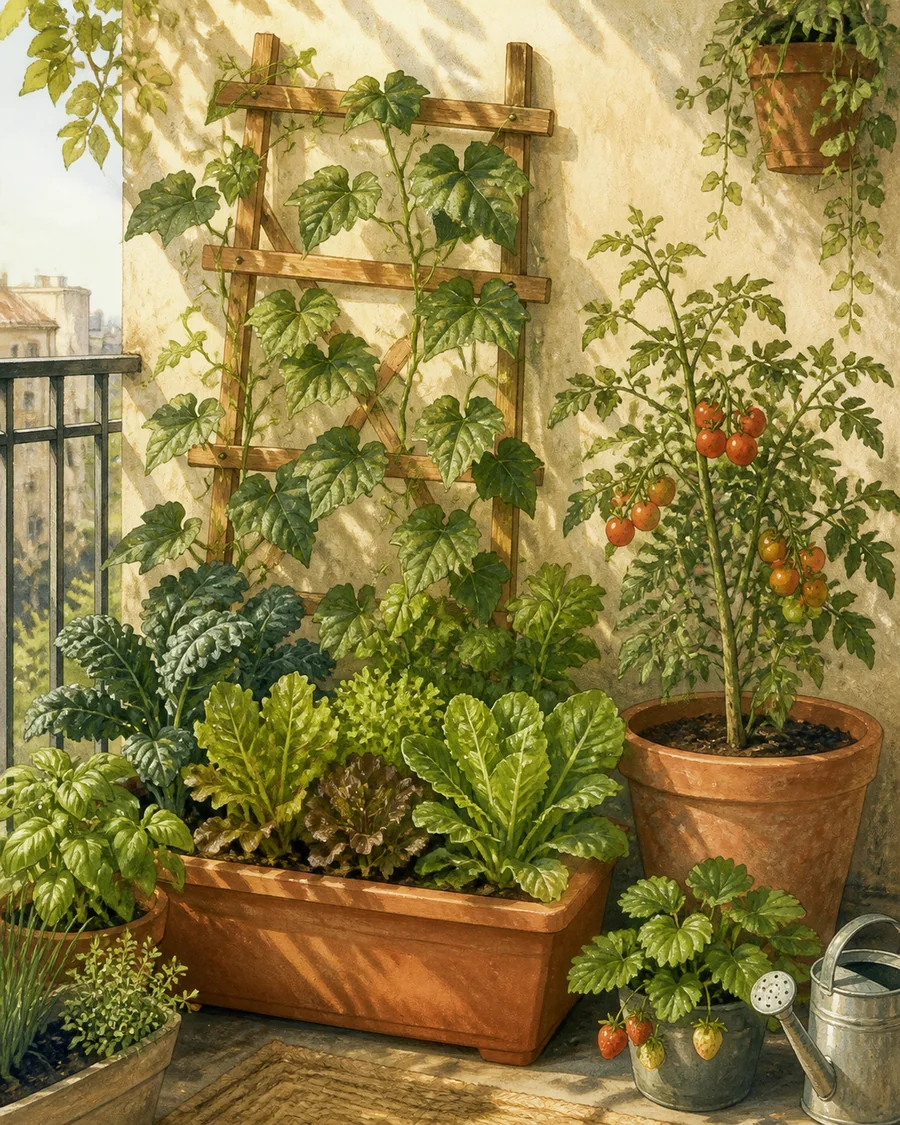
Quick start
Record usable floor area, safe access and the mature room plants need—not just the empty footprint today.
Most fruiting vegetables, including tomatoes, peppers and cucumbers, need 6+ hours of direct sun. Root crops can manage with 4–6 hours, while leafy greens and herbs can get by with about 3 hours.
Use containers for flexibility, a raised bed for a permanent growing area, and height when a crop genuinely climbs.
Choose with purpose
The best list is not simply the smallest plants. Balance quick crops, compact crops, vertical growers and plants that keep producing.
Leaf lettuce, spinach, radishes, green onions and carrots can use beds or broad shared planters efficiently.
Pole beans and vining cucumbers can trade sprawling ground growth for a secure, harvestable trellis.
Tomatoes, peppers and Swiss chard can earn their footprint over a longer season when conditions suit them.
| Crop | Light starting point | Container guidance | Spacing | Support |
|---|---|---|---|---|
| Leaf lettuce | 3+ hrs; ideally 5+ | 2+ gal shared planter | 4–6 in | None |
| Spinach | 3+ hrs; ideally 5+ | 2+ gal shared planter | 1–2 in after thinning | None |
| Swiss chard | 4+ hrs; ideally 6+ | 2+ gal | 4–6 in | None |
| Green onions | 4+ hrs; ideally 6+ | 2+ gal shared planter | 2–3 in | None |
| Radishes | 4+ hrs; ideally 6+ | 2+ gal shallow planter | 1–2 in | None |
| Carrots | 5+ hrs; ideally 6+ | 3+ gal; depth must suit variety | 2–3 in | None |
| Bush beans | 6+ hrs; ideally 8+ | 5 gal shared container | 2–3 in | Usually none |
| Pole beans | 6+ hrs; ideally 8+ | 5+ gal | Follow cultivar | Trellis required |
| Vining cucumber | 6+ hrs; ideally 8+ | 5+ gal | 14–18 in | Strong trellis |
| Pepper | 6+ hrs; ideally 8+ | 5 gal per plant | 1 plant/container | Sometimes helpful |
| Cherry tomato | 6+ hrs; ideally 8+ | 5+ gal per plant | 1 plant/container | Stake or cage |
| Compact tomato | 6+ hrs; ideally 8+ | 5+ gal per plant | 1 plant/container | Check cultivar |
Use these as conservative beginner planning defaults. Always follow the exact cultivar instructions and local growing guidance.
Pick a growing method
Best for balconies, patios, paved spaces and rentals. They offer flexibility but dry faster and need a suitable growing medium and drainage.
Useful for a permanent sunny yard. Make the bed narrow enough to reach the middle without stepping on the soil.
A companion technique, not a separate garden. Use it for crops that climb or benefit from support, and account for shade and wind.
Free printable resource
Not sure what will actually fit? Compare 20 vegetables by container size, spacing, sunlight, harvest time and vertical-growing potential.
Explore the planner →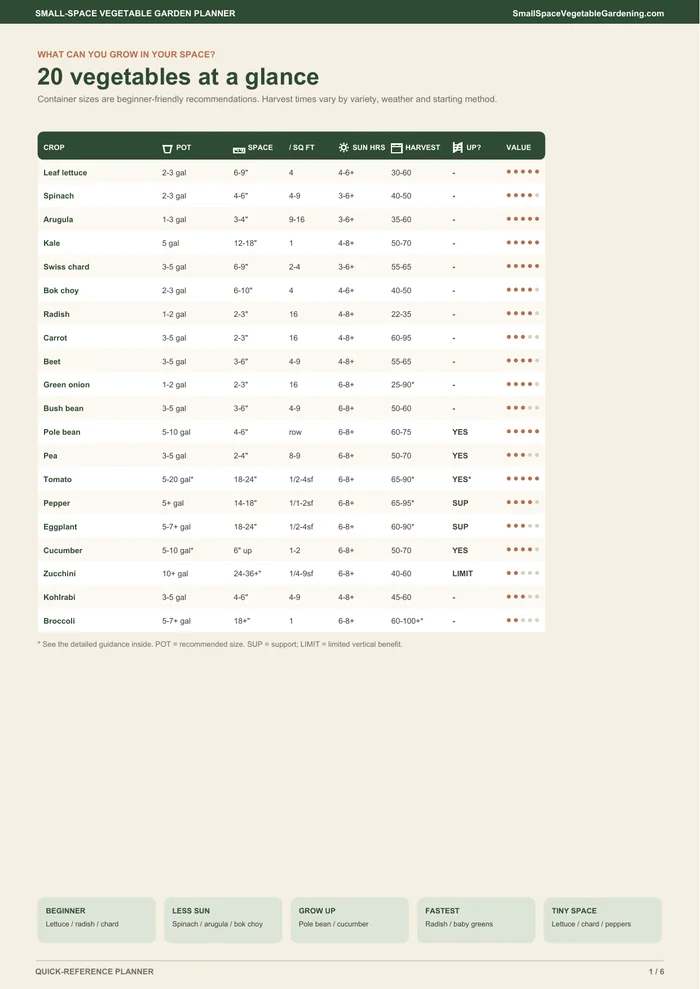
Free decision tool
Answer four questions here, or use the full Small-Space Vegetable Garden Planner to compare all 20 crops and download the printable worksheet. This tool does not guess your climate or planting dates.
Original layout ideas
Use these diagrams as organizing principles, not rigid planting maps. Adjust every crop to its cultivar, sun direction and your ability to reach it.
Container guide
Small leafy crops can share wide planters. For larger fruiting plants, our beginner recommendation starts around five gallons per plant for tomatoes and peppers, and five gallons or more for many cucumber setups.
Carrots need a different calculation: the container must be deep enough for the mature root length. Short or round cultivars help where depth is limited.
Healthy container foundations
Garden soil compacts in containers and drains poorly.
Every container needs drainage holes; elevate pots slightly so water escapes.
Containers dry out much faster than beds. Small pots may need daily watering in summer heat, so use a finger test instead of relying on a fixed schedule.
Use space well
Install secure supports early. Keep harvests reachable and avoid turning half the garden into shade.
Look for mature-size details and terms such as compact, dwarf, patio, bush or determinate.
After a quick crop finishes, replant only when the season and local conditions suit the next crop.
Green onions, herbs or quick greens may use open edges without crowding a large central crop.
Put frequently harvested crops where you can reach them. Leave room to water, inspect and prune.
A tiny garden works better when every crop earns its space in your kitchen, not just on a generic list.
Avoid the usual trouble
Common questions
Yes. Containers, raised beds, window boxes and supported climbing plants can make balconies, patios and small yards productive. Light, root space, water and mature plant size matter more than whether the area looks like a traditional garden.
Leaf lettuce, radishes and green onions use little room; pole beans and cucumbers can use height; tomatoes, peppers and Swiss chard can produce over a longer period. Your sunlight should narrow the list first.
Around 3–4 hours can support some leafy crops; 5–6 hours adds selected roots; 6 or more broadens the choice, and many fruiting vegetables perform best with 8 or more. These are planning ranges, not guarantees.
Potentially. You need sufficient direct sun, a container around five gallons or larger, a manageable cultivar, reliable watering, support, and a safe position considering weight and wind.
There is no universal size. Our beginner defaults start around five gallons per tomato, pepper or cucumber plant; leafy greens can share wider planters; carrot depth must match mature root length.
Use a quality potting or container-growing medium and provide drainage holes. Dense garden soil alone can hold too much water and too little air when confined in a pot.
Containers suit balconies, paved areas, rentals and flexible layouts. Raised beds suit a permanent sunny yard with comfortable access. A combination may use the space best.
Train suitable pole beans, climbing peas, vining cucumbers or supported tomatoes onto a secure support. Position it so mature growth does not unnecessarily shade shorter crops.
Editorial approach
Plant-light, spacing, container and growing-method recommendations were checked against university Extension and horticultural guidance. Where reputable sources differ, we avoid presenting one minimum as universal and favor more forgiving beginner recommendations.
These organizations do not sponsor or endorse this website. For planting dates and regional advice, consult a reputable local horticultural source.
Begin simply
Measure it. Watch the sunlight. Choose a few suitable crops. Give their roots room. Use height when it truly saves space.
Plan my garden ↑